Most physicians leave their training with deep clinical expertise and almost no idea how to run a business.
Mark Leary, an implementer of the Entrepreneurial Operating System, spoke at PPA’s 2025 Annual Meeting about tools for getting the right people in the right seats. The good news is that a handful of focused tools can change the trajectory of an entrepreneurial practice.
The Entrepreneurial Operating System (EOS) was created by Gino Wickman after he observed that only one in 20 entrepreneurs actually got what they wanted from their businesses. The other 19 were stuck.
When Wickman examined the difference, he found that successful businesses weren’t doing revolutionary work. They were simply disciplined in the fundamentals everyone already knew: vision, culture, people, and accountability. EOS distills those fundamentals into a repeatable system.
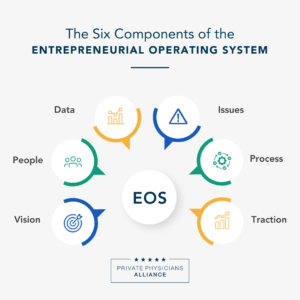
The Six Components of the Entrepreneurial Operating System
Leary explained that most practice leaders juggle 136 issues on any given day. Over time, they get comfortable managing about 20 of those; 116 sit neglected on the floor.
The Entrepreneurial Operating System argues that focusing on six components causes the rest to fall into line. Those six components are vision, people, data, issues, process, and traction. To elaborate:
- Vision aligns leadership on direction.
- People ensure the right individuals occupy the right roles.
- Data cuts through emotions.
- Issues create space for honest problem-solving.
- Process simplifies operations.
- Traction tracks progress so the vision doesn’t remain a hallucination.
Most organizations Leary works with self-report at 20–40% strength across these components. Getting to 80% in each area produces a markedly different organization.
Get the Right People in the Right Seats
Leary focused his session on the people component, which he called the source of most business problems. Profit issues, growth issues, and operational issues almost always trace back to people issues.
The people component has two parts: the right people and the right seats.
The Right People
“The right people” means the right cultural fit. Leary introduced core values as a culture filter: a handful of timeless principles that determine who belongs.
He cautioned against two mistakes:
- Aspirational values: Principles you wish defined your organization but don’t describe how it operates today.
- Permission-to-play values: Baseline expectations that don’t differentiate you. For instance, “honesty” at a bank tells prospective team members little of value.
Effective core values are specific enough to filter candidates and memorable enough for everyone to recite. Three to five values work better than seven.
Once established, every team member can be rated on a simple scale: plus (shares this value most of the time), plus-minus (sometimes), or minus (not really). The exercise quickly reveals who fits the culture and who would thrive elsewhere.
The Right Seats
“Right seats” addresses a different problem.
Leary asked how many physicians in the room had been hired with a job description that amounted to “doctoring.” Nearly every hand went up.
The Entrepreneurial Operating System uses the accountability chart to define what the organization needs before deciding who fills each role. The process starts at the bottom: Identify three to seven major functions the practice must execute well over the next three to six months. From there, each function gets defined by five roles.
The structure must be customized. A practice with separate clinical and esthetics operations will look different from one focused on primary care. The goal is stripping out unnecessary complexity, which Leary called expensive, unreliable, and high-risk.
For physician-owned practices, the accountability chart forces a difficult conversation. Founders must choose whether they function as a visionary, an integrator, or an individual contributor. Many occupy all three roles without acknowledging the tension. The accountability chart makes those competing responsibilities visible.
GWC: The Seat-Fit Test
Once seats are defined, EOS uses a three-part test called GWC: gets it, wants it, and has the capacity to do it:
- Gets it means the person understands the role and can articulate what success looks like.
- Wants it means genuine desire, not mere willingness. Leary emphasized that leaders cannot motivate their staff; they can only find people already motivated by the work itself.
- Capacity means the person can actually perform the role. A talented clinician promoted to management may lack the capacity for process discipline, regardless of how much they want to succeed.
All three answers must be yes. A person who doesn’t get it rows in the wrong direction. A person who doesn’t want it doesn’t row at all. A person without capacity makes splashes but goes nowhere.
Two People Problems
Leary identified two patterns that plague most organizations.
The first is right person, wrong seat: someone who fits the culture but occupies a role that doesn’t match their abilities. The compassionate clinician promoted to management who hates process work falls into this category.
The second pattern is wrong person, right seat: someone who excels at their job but doesn’t share the organization’s values. These high performers often produce 30–50% more than their peers, yet they poison the culture.
Both patterns require action. Keeping a wrong-seat employee in place harms both the employee and the organization. Tolerating an employee who is the wrong person signals that values are negotiable.
Structure First, People Second
Don’t treat the accountability chart as a one-time exercise. Visit it at least quarterly. Ask yourself, “What does the organization need over the next three to six months? Who can fill those seats?”
Leary’s final message was that complexity is the enemy. Practices succeed when they simplify roles, clarify expectations, and hold everyone accountable to a shared vision.
The tools are straightforward. The discipline to use them consistently separates thriving practices from stuck ones.
Sessions like this one are part of what makes PPA’s Annual Meeting valuable for entrepreneurial physicians building sustainable practices. Members gain year-round access to peer discussions, monthly webinars, and a network of physicians implementing these frameworks in their own organizations. Learn more about PPA membership today.