What Happens if a Partner Can’t Practice? Key Person Insurance for Private Practices
Learn how key person disability insurance protects multi-physician medical practices from lost revenue and recruitment costs when a partner stops working.

Most physicians carry malpractice and umbrella policies as a matter of course. Far fewer have looked closely at key person insurance until a partner becomes disabled or dies suddenly.
For single-physician practices not looking to add partners, the policy may never apply. For multi-partner practices and those scaling toward partnership, it’s worth understanding before the worst-case scenario becomes reality.
A multi-physician practice depends on each partner actively generating revenue. Losing a partner creates a two-part financial hit: lost revenue from their patient panel and the cost of recruiting and onboarding a replacement.
Key person coverage is designed to protect the practice from that business disruption, separate from the physician’s personal disability or life insurance.
What Is Key Person Disability Insurance?
A medical practice is different from product-based businesses. Revenue doesn’t come from inventory; it comes from physicians actively seeing patients. Those physicians’ health and availability are the business.
Key person insurance addresses what happens when one of those physicians can no longer participate. Unlike a personal policy, it’s owned by the practice and pays out to the practice. Personal disability insurance covers the physician’s income if they can’t work; key person disability insurance covers the practice’s financial loss when they can’t see patients.
Key person disability insurance protects the business itself when a partner becomes unable to work, separate from any personal disability coverage the physician carries. The same logic applies to key person life insurance, which addresses the death scenario. Practices commonly hold both, sometimes on the same partner.

How Key Person Disability Insurance Covers Replacement Costs
When a partner becomes disabled or dies, the practice incurs lost revenue and recruitment costs simultaneously. Both expenses arrive at a time when the practice is already absorbing a significant operational shock.
For short-term disability, the practice may redistribute the workload to other partners. That’s a workable bridge for weeks, not months. For longer absences or permanent disability, the practice must recruit a replacement physician to assume the disabled partner’s panel.
Replacing a seasoned physician with a full patient panel takes time and money. Recruitment, signing incentives, ramp time, and the disruption to existing patient relationships all factor in. The replacement may need to be enticed away from another practice on short order.
Key person disability insurance pays out to the practice to offset lost revenue and fund the recruitment of a temporary or permanent replacement. Key person life insurance does the same in the event of a partner’s death, with the added urgency that replacement must begin immediately.
The financial logic mirrors the broader thinking behind scaling a medical practice: protect revenue while you absorb costs.
Coordinating Key Person Coverage With Buy-Sell Agreements
Replacing a partner is only part of the problem. The practice also has to buy out the partner’s ownership stake, which requires significant capital.
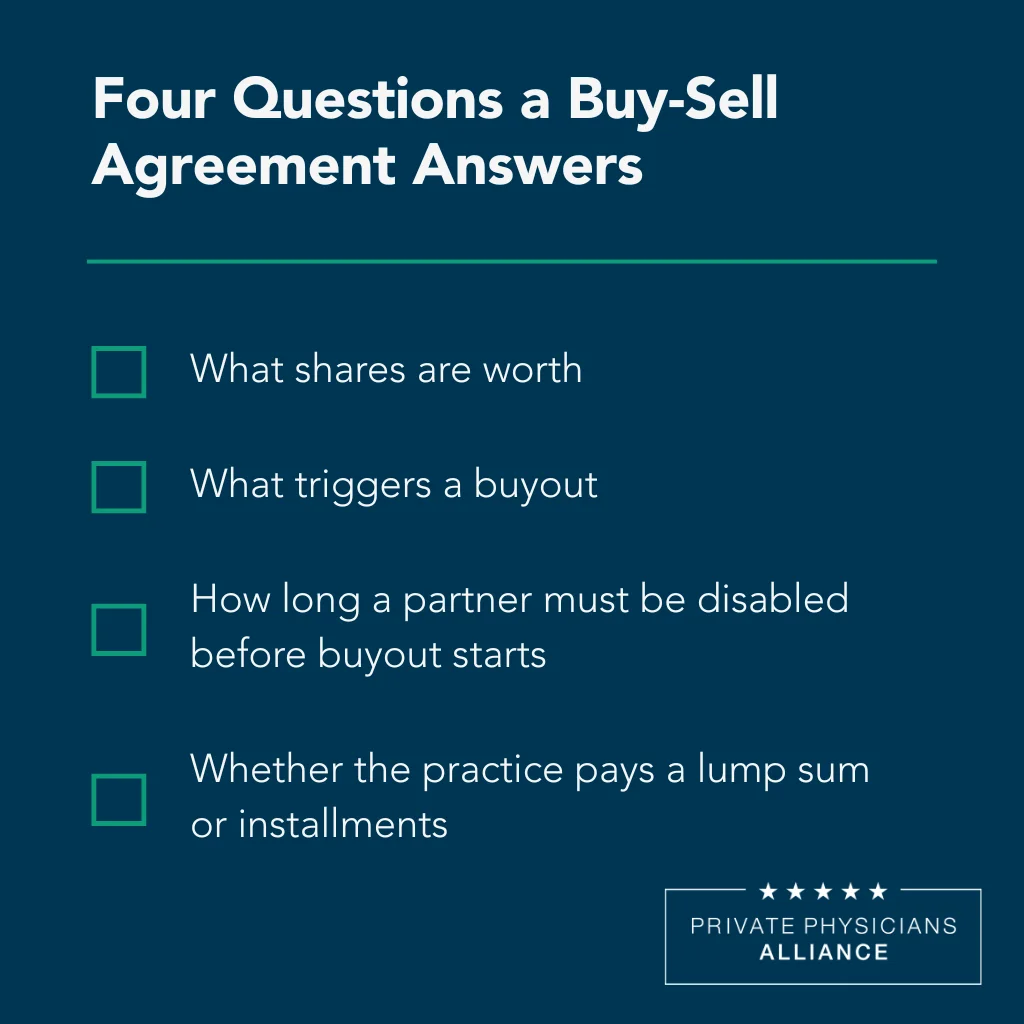
A buy-sell agreement is the legal document that defines how the buyout happens. It answers four questions:
- What shares are worth
- What triggers a buyout
- How long a partner must be disabled before buyout starts
- Whether the practice pays a lump sum or installments
The agreement also specifies the funding source, which is typically a combination of disability and life policies.
Most physicians think carefully about malpractice coverage. Far fewer think about what happens to the practice if a revenue-generating partner becomes disabled, dies unexpectedly, or can no longer see patients.
Buy-sell agreements are often coordinated with disability and life insurance coverage so the practice has a clearer funding plan if a partner can no longer participate. Without that funding, surviving partners may scramble for capital or end up with a deceased partner’s spouse holding equity in the practice. Both create problems that proper coverage prevents.
The agreement only works if the valuation stays current. Most practices review the buy-sell agreement every one to two years and update the valuation accordingly. Key person insurance funds the buyout up to the documented valuation, not whatever the shares are worth today, so a stale number leaves the practice exposed for the difference.
For partner-track practices, this directly influences long-term private practice profitability and the value of equity in the business.
What to Know Before Buying Key Person Disability Insurance
A few practical points come up in nearly every key person insurance conversation.
This is not a one-size-fits-all product. The right structure depends on ownership, revenue concentration, partner agreements, valuation, and tax treatment.
Medical underwriting is required for both disability and life policies, with disability underwriting typically more stringent. Exams usually include blood work, urinalysis, physical measurements, and sometimes an EKG depending on age. The same exam usually covers both policy types when a practice applies for both at once.
Non-owner physicians can be covered. Many practices take out policies on contributing non-owner physicians who generate substantial revenue and are similarly hard to replace. The physician must agree to the policy and coverage amount.
Contractor arrangements can also use key person coverage. Even physicians who share overhead rather than ownership can take out policies on one another to protect against losing a contributing doctor.
Cost varies significantly based on age, health, coverage amount, and policy structure. Tax treatment of premiums and payouts has specific rules that affect how the policy should be structured.
Structuring key person disability insurance well requires input from your attorney, CPA, and an experienced insurance agent. Each professional weighs in on a different piece, and the right policy depends on how those pieces fit together.
Practices building this kind of financial protection often benefit from a broader practice management framework that ties risk planning to day-to-day operations.
These are exactly the kinds of risks that are easy to ignore when a practice is healthy and busy, but painful to address after something goes wrong. Inside the Private Physicians Alliance, members discuss practice protection, buy-sell planning, advisor recommendations, and operational safeguards through private forums and monthly webinars. If you’re looking for a peer network where concierge and DPC physicians openly discuss the business side of practice ownership, learn more about PPA membership.