How Should We Interpret the NHS-Galleri Study Results?
Learn how physicians use a clinical decision framework to evaluate the mixed NHS-Galleri multi-cancer screening study results despite incomplete evidence.

The PPA Technology and Innovation Committee provides evidence-based guidance on emerging medical technologies. Our work, however, confronts an inherent challenge: the newer the technology, the weaker the available evidence.
This position paper proposes a framework for evaluating new technologies in the setting of incomplete evidence. The recently released NHS-Galleri study provides an instructive example.
What the NHS-Galleri Study Found
Grail recently reported results from the NHS-Galleri study, a three-year, 140,000-participant randomized controlled trial evaluating a multi-cancer early detection blood test. The study produced mixed findings.
The trial failed to meet its primary endpoint of reducing the overall incidence of stage III and IV cancers at diagnosis. But several secondary outcomes were encouraging, including a statistically significant reduction in stage IV cancer diagnoses and increased detection of earlier-stage cancers.
The NHS-Galleri study doesn’t provide a definitive answer on Galleri’s clinical utility, but it does alter our estimate of the probability the test may offer meaningful clinical benefit. This study alone won’t settle the debate over Galleri’s appropriate use.
A Clinical Framework for Technology Assessment
Physicians routinely make decisions under uncertainty. Three principles that guide clinical decision-making can also guide technology assessment:
- Clinical decisions are rarely binary. Instead, we make probabilistic assessments that range from near zero to near certainty.
- We establish probability thresholds at which we’re willing to take action.
- We evaluate risks and benefits from the perspective of the individual or organization affected by the decision.
Consider a patient presenting to the emergency department with chest pain. Based on the history, physical examination, and risk factors, we estimate a pretest probability of myocardial infarction. We don’t require certainty before initiating a diagnostic evaluation.
As additional information becomes available, our estimate of probability changes. Once we reach a threshold, we proceed with further testing, hospitalization, or treatment. We base our decision on the risks and benefits to that individual patient.
The same framework applies to the NHS-Galleri results. The first question isn’t whether Galleri definitively works or doesn’t work. The more relevant question is: What is the probability Galleri provides meaningful clinical benefit, and has that probability crossed the threshold required for action?
The answer depends largely on the decision-maker’s perspective.
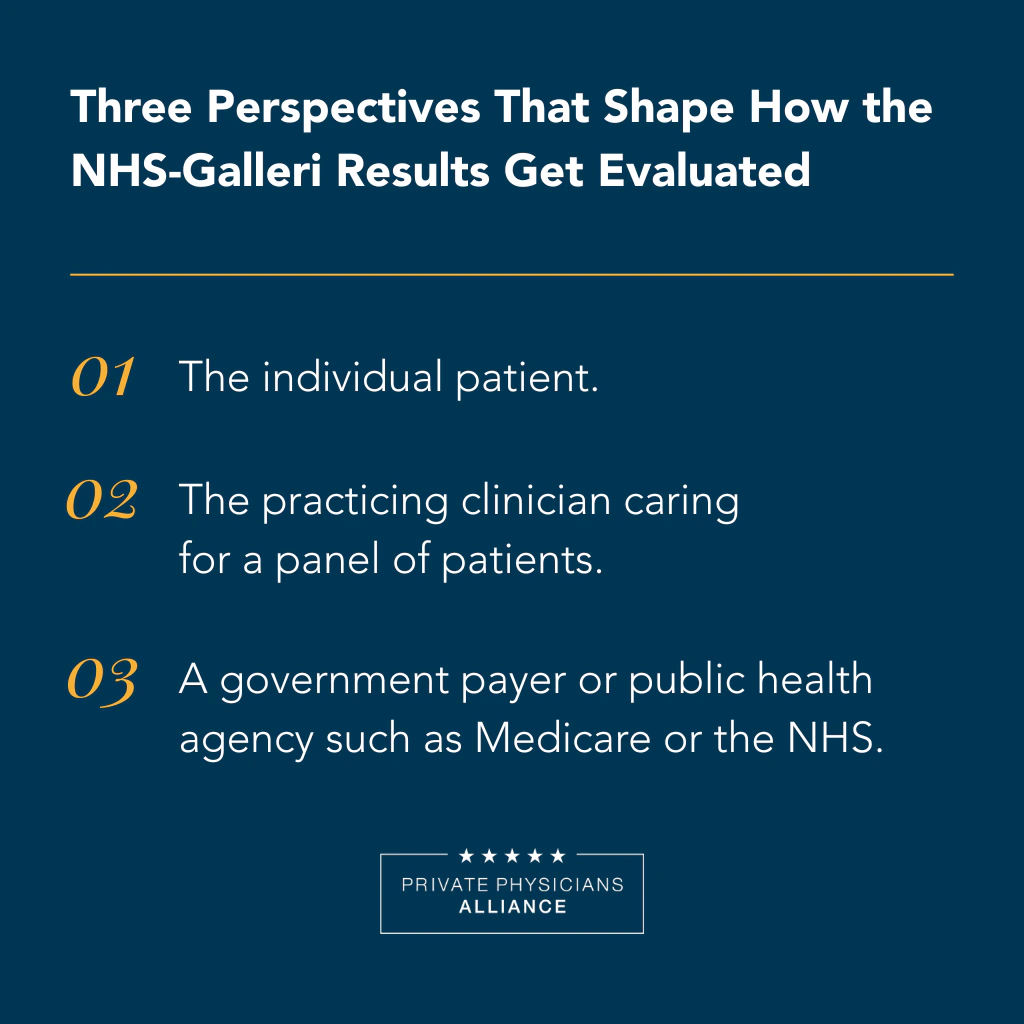
Three Perspectives on the Same Evidence
Three relevant perspectives shape how we evaluate the NHS-Galleri results:
- The individual patient.
- The practicing clinician caring for a panel of patients.
- A government payer or public health agency such as Medicare or the NHS.
Each perspective faces a different balance of risks and benefits and therefore requires a different threshold of evidence.
From my personal perspective, I have a strong family history of cancer. My mother died at age 60 from metastatic breast cancer, and my father died at age 71 from pancreatic cancer.
Given that history, I elected to undergo Galleri testing as soon as it became available. For me, the possibility of earlier cancer detection justified the financial cost and uncertainty surrounding efficacy.
A government payer faces a different decision. Medicare or the NHS must weigh potential patient benefit against resource allocation across an entire population.
Billions of dollars may be spent on testing, follow-up imaging, specialist consultations, and diagnostic procedures generated by positive results. Every dollar spent on Galleri is a dollar unavailable for other healthcare priorities. The opportunity cost of adopting the test prematurely may be substantial.
Public health agencies appropriately require a much higher level of evidence before recommending or funding widespread implementation.
Where Clinicians Stand
Clinicians occupy a middle ground. Unlike government payers, our primary responsibility is to individual patients rather than population-level resource allocation. At the same time, we must remain scientifically rigorous and avoid overstating the available evidence.
The NHS-Galleri study didn’t show a reduction in cancer mortality. It didn’t prove widespread use of Galleri saves lives. Concerns remain about overdiagnosis, downstream testing, false-positive findings, cost-effectiveness, and long-term clinical outcomes.
The study did provide evidence suggesting Galleri can identify certain aggressive cancers at earlier stages and reduce the incidence of stage IV disease at diagnosis. These findings increase the probability the test may provide clinically meaningful benefit.
The remaining question is whether that probability exceeds the threshold for recommending the test to appropriate patients.
For many concierge medicine patients, the financial burden of testing is manageable. The reported false-positive rate is relatively low: approximately one in 200 individuals tested. Many patients are willing to accept the possibility of additional testing, uncertainty, and anxiety in exchange for a chance to detect an otherwise occult cancer at an earlier stage.
For these patients, the possibility of benefit may reasonably outweigh the known risks, even though definitive mortality data remain unavailable.
I’d argue the NHS-Galleri results have crossed the threshold at which many clinicians can reasonably discuss and offer the test to appropriately informed patients. This conclusion isn’t based on certainty, nor does it imply the evidence is complete. It reflects a judgment that the current balance of probabilities and risks supports selective clinical use.
Reasonable clinicians may disagree. Medicare and the NHS may appropriately decide the current evidence remains insufficient to justify population-wide adoption.
Those aren’t contradictory positions. They simply reflect different thresholds for action based on different responsibilities and risk-benefit calculations.
As clinicians, our task isn’t to wait for perfect certainty. It’s to help patients make informed decisions in the face of uncertainty. Viewed through that lens, the NHS-Galleri study provides evidence many physicians and patients may find sufficient to justify considering this test today, while awaiting further data in the years ahead.
PPA’s Technology and Innovation Committee evaluates emerging medical technologies and shares evidence-based guidance with members year-round. PPA members gain access to the committee’s position papers, peer discussions, monthly webinars, and a network of entrepreneurial physicians assessing these tools in their own practices. Learn more about PPA membership today.
Written by Dr. Barry Rotman, PPA Board Member and Founder of Banner Peak Health in Walnut Creek, California.