Build the Team to Scale: A Hiring Playbook for Private Practices
Learn four hiring principles from a concierge practice COO that help entrepreneurial physicians scale a practice without costly mistakes or rushed hires.

Most entrepreneurial physicians eventually hit the same wall. The practice is busy, the panel is full, and the only way forward is to hire.
But hiring well is its own discipline, and most physicians weren’t taught it.
In a recent Private Physicians Alliance Afternoon Report session, Joe Rizzuto, COO of Priority Physicians, walked attendees through what he’s learned about hiring for scale. He’s been in the role since 2010, when the practice had three to four doctors and a single office of around 6,000 square feet. Four practical hiring principles stood out.
Play #1: Know What You’re Hiring Toward
Hiring decisions get easier when the practice already knows what it stands for.
Vision, mission, and values aren’t a wall poster. Leaders have to communicate them through behavior, onboarding, and meeting cadence. Without that clarity, every hiring conversation starts from scratch.
Joe shared a phrase he uses often: “Hope is not strategy.” Practices stuck in day-to-day operations rarely create space to think one, three, or five years ahead. Without that map, it’s hard to know what kind of person to hire next.
Hiring gets easier once the practice knows its purpose, growth goals, and leadership standards. Joe encouraged attendees to block off protected planning time, what he calls sacred time. The point is to map out growth goals and future hires rather than rely on wishful thinking.
Culture flows from the same foundation. Joe noted culture starts early, often when a practice has only a few people, and it grows through repetition. Leaders who say their values matter every day have to back it up with behavior, or staff stop believing the words.
Joe made the point repeatedly: the clearer the practice gets about its values, the better it becomes at recruiting people who share them.
Play #2: Build the Org Chart Before Posting the Job
Joe encouraged practices to evaluate the structure their practice needs before adding a name to it.
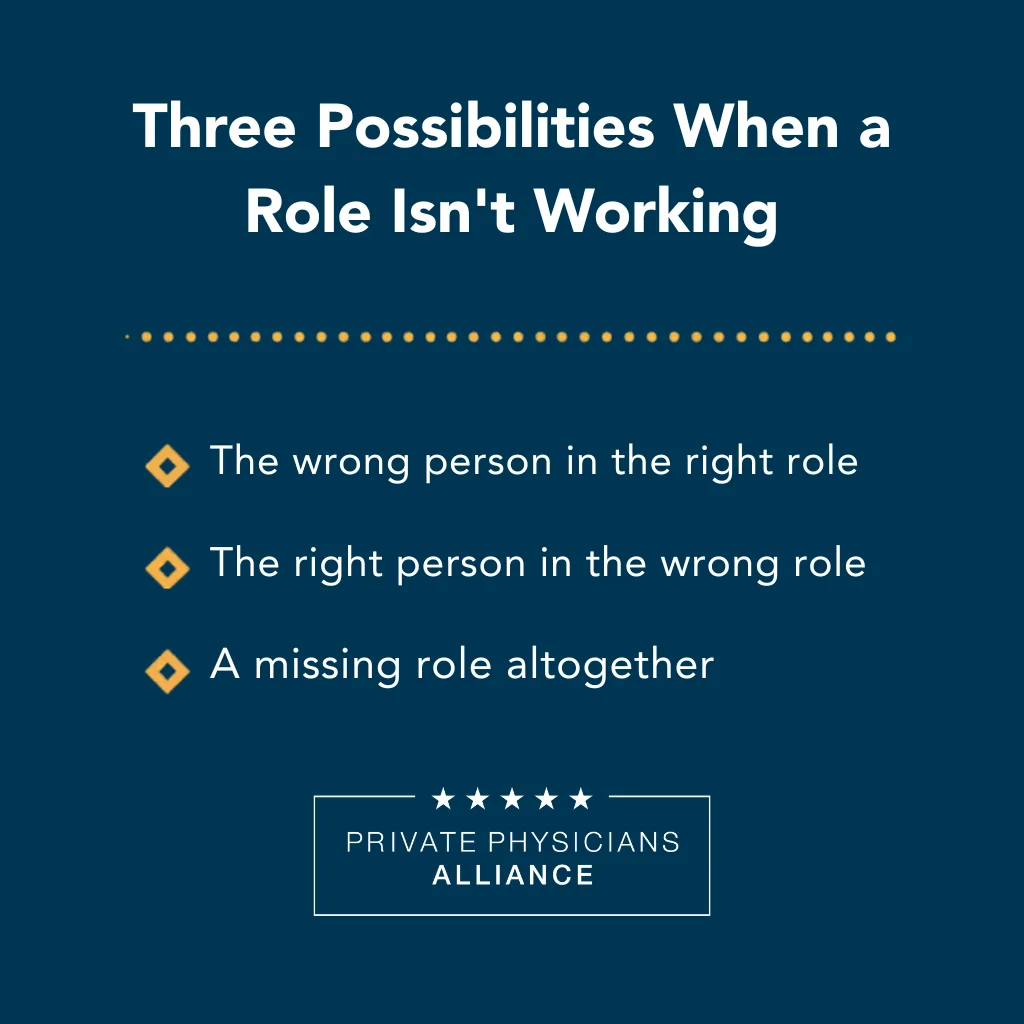
His diagnostic boils down to three possibilities: the wrong person in the right role, the right person in the wrong role, or a missing role altogether. Each possibility points to a different solution, and only one of them is “hire someone new.”
Defining the org chart first turns hiring into a decision, not a reaction. Joe suggested building the org chart two years out, identifying the empty boxes, and deciding which to fill first. The exercise often surfaces gaps a panicked hire wouldn’t have addressed.
Joe pointed out that as practices scale, tools and reporting methods have to evolve. The core priorities stay constant, even as the metrics around them shift.
Joe offered a second framing: “Inspect what you expect.” Naming a priority once doesn’t make it stick. Leaders have to revisit goals, reinforce them often, and narrow the list to a manageable number so teams stay focused.
Without that follow-through, even strong hires drift. Accountability comes from repeated attention, not from a single conversation.
Play #3: Fish Where the Right Candidates Already Are
Joe’s advice on recruiting was direct: don’t post a job and wait.
His phrase for it is “fish where they are.” That means showing up in the spaces where ideal candidates already gather. LinkedIn, Indeed, Facebook groups, niche professional communities, and direct outreach through trusted networks like medical school alumni connections all qualify.
One member practice recently filled a physician role through a combination of alumni connections and targeted LinkedIn outreach. That kind of approach tends to surface candidates who already have a relationship with the practice or someone the practice trusts.
Joe’s own practice built a similar pipeline. The team partnered with a local medical school to create a rotation for residents, who spend two weeks or a month shadowing the practice’s doctors a couple of times a year.
The practice is mindful of perception, since paying concierge patients don’t expect to see students shadowing their doctors. The rotation has become a pipeline for introducing residents to entrepreneurial medicine, and the practice has hired two doctors straight out of residency this way.
Recruiting is a long game, and visibility plus authenticity make every future hire easier. A practice with clear culture and consistent leadership becomes easier to recruit to over time, and current employees become its best ambassadors, giving future candidates a clearer sense of what the practice is really like.
Play #4: Don’t Let Urgency Lower the Bar
Joe’s most pointed warning was about timing.
He shared a story about hiring someone out of desperation when the practice was short-staffed. The fit was so poor that he had to let the person go three days later. The cost extended well beyond the wasted hiring cycle.
It disrupted the team and frustrated patients, and the role still needed filling.
Hiring under pressure carries real peril, with effects that ripple to the team and the patients. Joe’s broader point was about discipline. The pressure to fill a role quickly comes from operational stress, and that stress rarely disappears with the wrong hire.
He also offered a counterintuitive read on staffing imbalances. What feels like overstaffing is often a misalignment of roles, not a headcount problem. The fix may be redistribution rather than recruiting, or thinking through which new role the practice needs next, such as a patient experience manager.
Joe pointed to an old business school adage: “Slow to hire, fast to fire.” He urged attendees to check all the boxes, ask the hard questions, and resist the pressure to shortcut the process.
The hard questions aren’t whether the candidate would be fun to grab a beer with. They’re about whether the candidate has the specific skills the role demands, and whether they can tell stories that show they’ve handled those situations before. Reference checks, background checks, and drug screens fill in the rest.
A rushed hire does not solve an urgent staffing problem. It often creates a second problem.
Hiring is one of the hardest transitions for a growing private practice, especially when physicians are trying to scale without losing the culture that made the practice successful in the first place. Inside the Private Physicians Alliance, members share hiring strategies, role frameworks, recruiting tactics, and real-world lessons through private forums and monthly Afternoon Reports like the session that informed this blog post. If you’re looking for a peer network where concierge and DPC practices openly discuss what is actually working, learn more about PPA membership.