How to Scale a Concierge Practice Without Losing Your Culture
Scaling a concierge practice without losing its culture depends on a clear long-term vision and a brand bigger than the founder. Priority Physicians COO Joe Rizzuto on how to grow on your own terms.

Most concierge practices center on one physician’s personal relationships, service style, and reputation. That model works in the early years, but it can become the biggest barrier to growth when the founder’s time, energy, and availability hit their limits.
A recent PPA Afternoon Report session tackled the operational side of scaling a concierge practice: how to grow without sacrificing the patient experience that built the business. Joe Rizzuto, Chief Operating Officer at Priority Physicians, led the conversation.
Rizzuto joined Priority Physicians in 2010 as team member number 11, when the practice had four physicians and about 6,000 square feet of office space. The practice now operates three offices, is adding its 16th and 17th physicians this year, and expects to reach roughly 40,000 square feet by year’s end.
Start With the Vision, Not the Lease
Rizzuto opened with a clear directive: define where the practice needs to be in three to five years before making a single operational move.
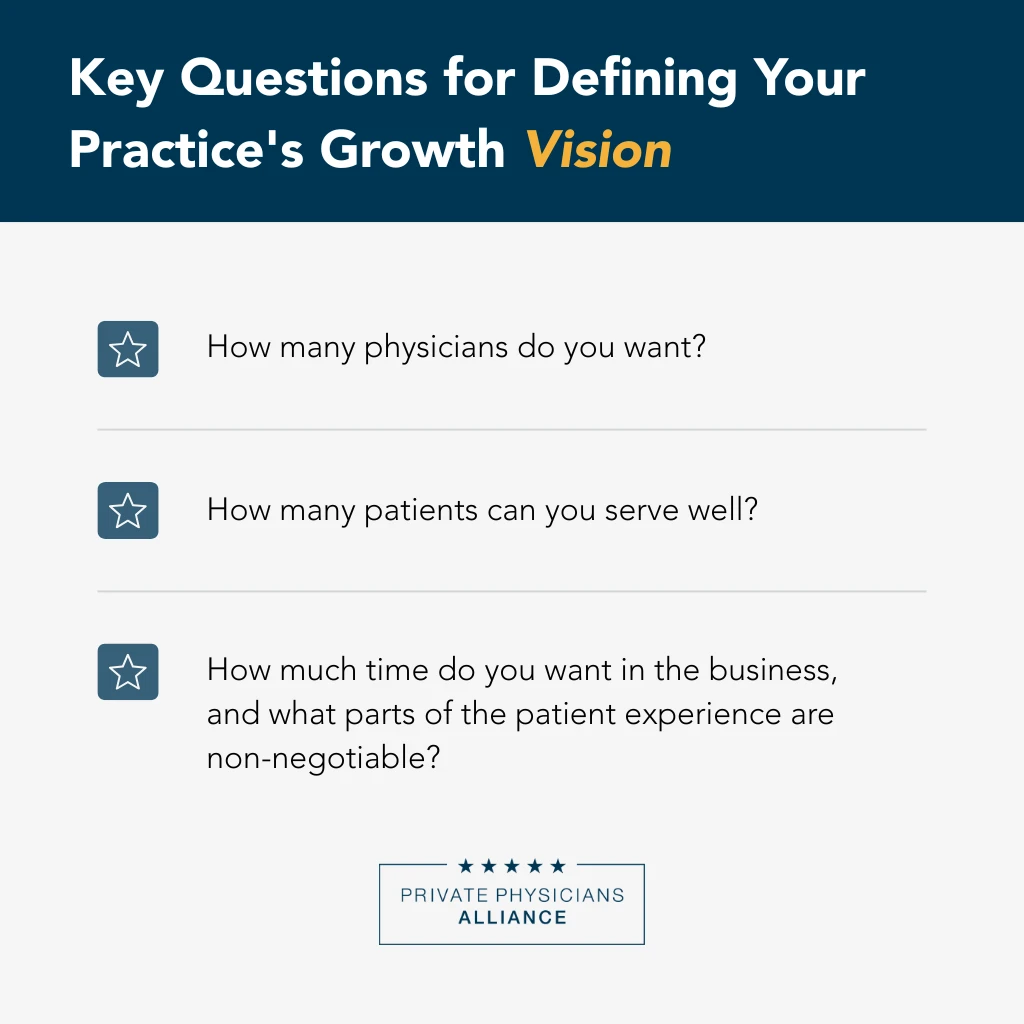
The planning starts by answering specific questions: How many physicians do you want? How many patients can you serve well? How much time do you want in the business, and what parts of the patient experience are non-negotiable?
Scaling a concierge practice starts with reverse-engineering growth decisions from a clearly defined future state, not reacting to demand as it arrives. “If you don’t know where you’re going, every road leads there,” Rizzuto said.
A practice can wake up in three years and see where it ended up, or it can decide now where it wants to land and build the structure to get there. Growth will happen either way. The question is whether growth happens on the founder’s terms.
From “Me” to “We”
The hardest transition for founder-led practices is moving from a personal brand to a practice brand. A practice built entirely around the founder has no transferable value. If the founder can’t work or decides to step away, the business has no plan B.
When Rizzuto started at Priority Physicians, he told the founding physicians the practice would be “about the we, not the me.” That principle shaped hiring, patient communication, and every operational message from day one.
Call coverage is the clearest example of the brand change. Many concierge physicians feel personal call is part of the promise they made to patients. Rizzuto reframed shared call as a benefit, not a concession: “We’re creating a solution for you, the patient, to make sure you’re always connected with a great team of doctors.”
When scaling a concierge practice, the brand experience can’t depend on a single physician’s availability. One member shared that sending patients a letter two weeks before a physician’s vacation produced fewer calls during the absence, not more. Patients respected the transparency, and some scheduled visits before the break.
Expectation-setting applies to hiring, too. Rizzuto advised framing growth as an improvement for patients, not a dilution of the relationship. The message to patients: the practice is building a stronger care team with better coverage, continuity, and support.
Across every operational change, the core principle stays the same: set the expectation before the patient forms their own. “If you don’t set an expectation, the patient still will,” Rizzuto said. “They’re just not going to tell you what it is.”
Space That Matches the Brand
Rizzuto turned to real estate with a warning: don’t wait until the practice is out of room to start planning.
Priority Physicians moved into a new Carmel, Indiana, office in 2022 with about 14,000 square feet, up from 9,000. Rizzuto expected the additional capacity to last three to four years. The practice filled the space in two.
Real estate timelines make the capacity gap harder to close. Finding a location, negotiating lease terms, hiring contractors, and finishing a buildout takes at least a year. Priority Physicians’ newest ground-up construction project has taken over three years from an empty lot to a finished building.
When scaling a concierge practice, real estate decisions are brand decisions, not just cost decisions. The office environment shapes how patients assess quality before they see a physician. The space doesn’t need to be extravagant, but it needs to match the professionalism, privacy, and hospitality membership patients expect.
The lease-versus-buy question came up in the group discussion. One member who purchased office space described the value of control: full authority over buildout, no risk of a landlord declining to renew, and the confidence to invest in a space designed for the practice’s brand.
Rizzuto noted the tradeoff. Leasing offers more flexibility when a practice is still gauging its growth speed, while ownership makes sense when the investment in the space is long-term.
When Priority Physicians opened a second location in Fishers, Indiana, in 2016, the decision started with patient address heat mapping. Patients from the Fishers area were already driving more than an hour to reach the main office, and the suburb’s development projections pointed to strong future growth.
The cultural transition at the Fishers office proved harder than the real estate logistics. The Fishers location launched with a new staff, with one exception: a long-tenured team member was promoted to office manager.
“We didn’t replicate enough DNA the first time around, and it did develop a little bit of a different personality,” Rizzuto said. For the third location, Rizzuto’s team changed approach and moved at least one established physician and one experienced team member into the new space to carry the practice’s standards forward.
The Practical Starting Point
Every practice has a different starting point. A solo physician hiring a first associate faces different questions than a multi-physician group opening a third office. The planning discipline is the same: define the vision, build the brand beyond the founder, and match the physical space to both.
“You’ve got to not be afraid of taking that next step if you know that’s where you want to be,” Rizzuto said.
Private Physicians Alliance members can access the full recording of this Afternoon Report session, including the member Q&A on real estate decisions, hiring strategies, and patient communication approaches. Learn more about PPA membership to join the conversation.