How to Grow a Medical Practice: 3 Strategies to Scale Successfully
Explore proven strategies for scaling your medical practice beyond a full patient panel and maxed-out schedule without sacrificing control or capital.

Most entrepreneurial physicians hit the same ceiling: After years of building a successful practice, the patient panel is full, revenue is strong, and time is maxed out. The traditional playbook for how to grow a medical practice stops working.
The issue comes down to the difference between growth and scaling.
How to Grow a Medical Practice: Growth vs. Scaling
Growth means adding more patients and revenue, but it also increases demand on your time, energy, and capital. Results and resources are positively correlated.
For a sole owner and provider, this model has hard limits. A full panel leaves only one option for increasing profit: raising prices.
Taking on more members past that point would mean shortening visits, which puts the patient experience at risk. This is where many private physicians stall: on a plateau, wanting more, at the limit of their current approach.

Scaling works differently. You increase results without a proportional increase in resources. You remove the traditional constraints of time and capital to expand exponentially.
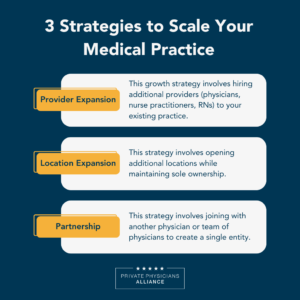
Three strategies allow entrepreneurial physicians to grow their practices effectively: provider expansion, location expansion, and partnership. Each differs across four factors: timeline, control, involvement, and required capital.

1. Provider Expansion
This growth strategy involves hiring additional providers (physicians, nurse practitioners, RNs) to your existing practice. You maintain complete ownership and operate in your current location while expanding patient capacity.
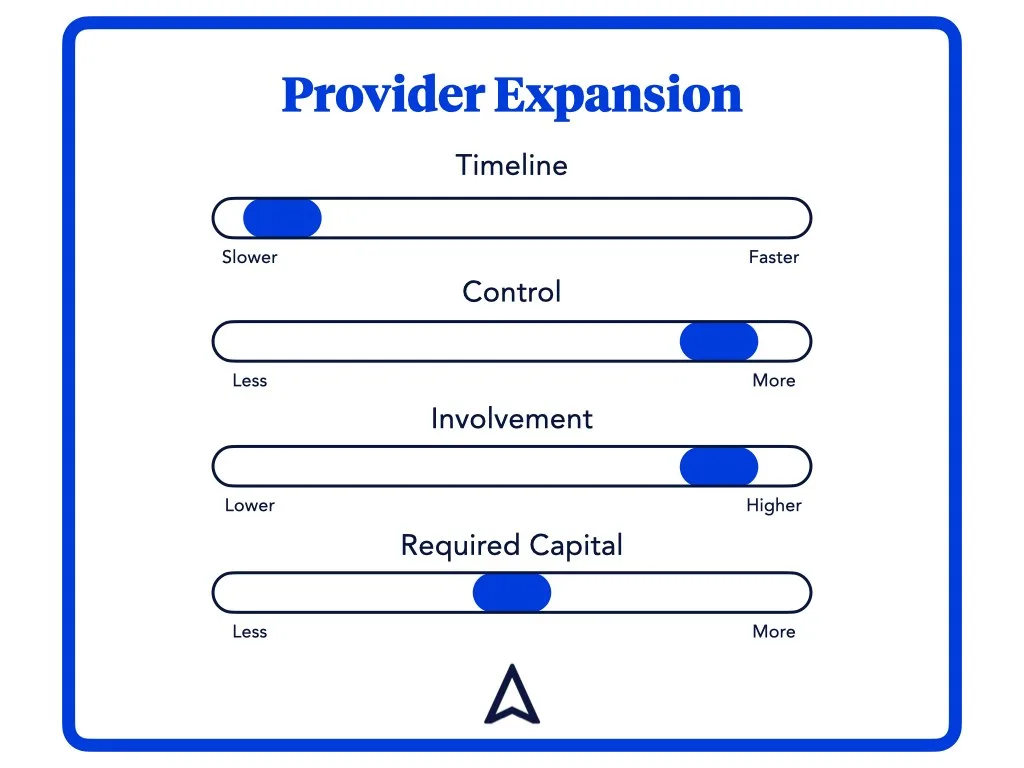
Timeline: Provider expansion takes the longest to scale. Finding the right provider for your practice is difficult and time-consuming. Even with additional capacity, there’s no immediate increase in market presence. Growth happens gradually as you serve more patients and begin marketing to new ones.
A slower timeline also carries market risk. While you are still recruiting, competitors with a larger footprint can move into your market and take some of your share.
Control: This is the biggest upside. You maintain full ownership and decision-making authority. You shape the culture and image of your practice, hire and fire staff as you see fit, and keep the highest share of profits.
Involvement: Being the sole owner and primary decision-maker means the highest level of involvement. While hiring, you’re still running the business and seeing a full patient panel. Once new providers are onboarded, your patient load can decrease, but you remain the owner, physician, and decision-maker.
Required Capital: Hiring providers isn’t cheap, but this strategy avoids the major debt associated with location expansion. As the owner, you’re responsible for paying new providers and helping them fill their panels.
2. Location Expansion
This strategy involves opening additional locations while maintaining sole ownership. Physicians typically expand locations for three reasons: the existing space can’t accommodate new providers and patients, they want to serve similar patients in a different region, or they want to tap into new market segments where location convenience matters.
One PPA member practice, for example, opened a location in a downtown corporate suite to serve executives and entire departments from large companies in the area.
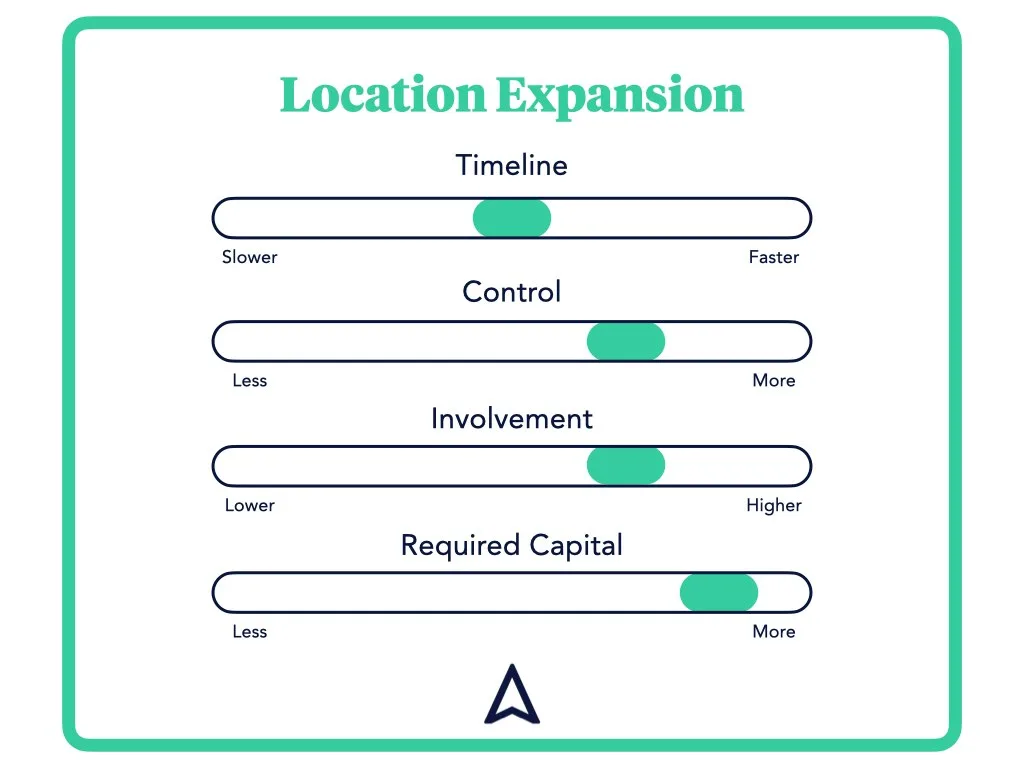
Timeline: Finding new providers remains the biggest constraint. But once you have staff available and increased capacity, scaling happens much faster than in a single-location practice.
Control: As the sole owner, you’re still the primary decision-maker. You can modernize the aesthetic of new offices and maintain authority over branding, marketing, staffing, and operations.
However, multiple locations mean staff and operations won’t fall under your immediate supervision. You aren’t sacrificing ownership, but control is slightly diminished. To attract top-caliber talent, you’ll likely need some type of equity incentive package, which slowly erodes control over time.
Involvement: You still have a high level of involvement, but staff will primarily run daily operations. You may still see patients regularly, but by necessity, you begin taking on more of an oversight role.
Required Capital: This strategy requires the largest capital investment. In addition to paying new staff and providers, leasing or buying another physical space carries significant upfront costs. Over time, increased patients and revenue compensate for this, but the initial expense is substantial.
3. Partnership
This strategy involves joining with another physician or team of physicians to create a single entity. You add more providers, staff, and likely more physical locations. But by partnering, you’re no longer the sole owner.
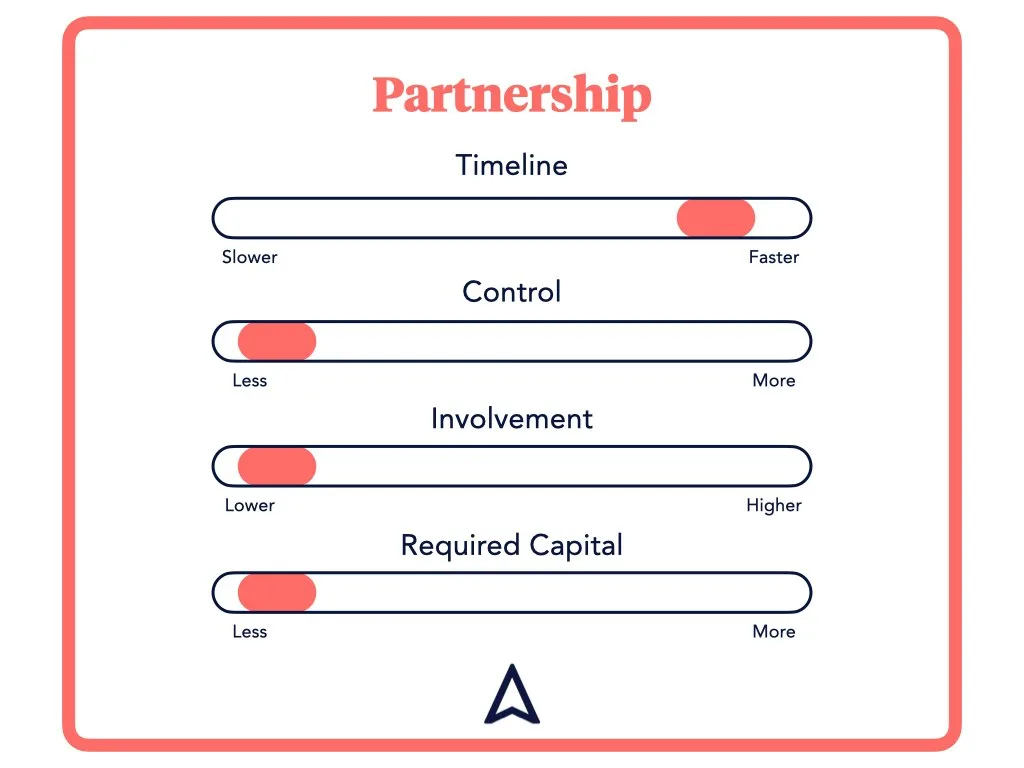
Timeline: Partnership is by far the fastest scaling strategy. Instead of seeking, vetting, and hiring new providers one by one, you join an entire group at once. This immediately increases your practice’s capacity to see new patients. With the influx of resources, you quickly gain a larger footprint in branding, marketing, and physical locations.
Control: The primary downside is the loss of control. As a partner, you’re no longer the sole owner, so decisions require group consensus. This includes decisions about staff, branding, and culture. Since ownership is shared, you’re entitled to a smaller share of total profits.
Involvement: Responsibility and financial risk are now shared. With more resources available, you can hire additional providers, which supplies more freedom in the business. This gives you the flexibility to adjust your call schedule more readily.
Required Capital: Partnership requires the least personal capital since you’re pooling resources with other physicians. Depending on your situation, you’ll likely have instant access to multiple facilities, providers, staff, and marketing budgets that would otherwise take significant money and time to acquire.
Your ownership share may be smaller, but so is your initial investment. With the potential for higher returns, a lower share in a partnership could outweigh a higher share in a sole-ownership practice.
Choosing Your Path
There’s no universal answer for how to grow a medical practice beyond its current ceiling. Each strategy offers distinct tradeoffs between speed, control, involvement, and capital requirements.
Provider expansion offers maximum control, but the slowest timeline. Location expansion accelerates growth but demands significant capital. Partnership delivers the fastest scale with the least personal investment, but requires sharing ownership and decision-making authority.
The right choice depends on your lifestyle goals, risk tolerance, succession plans, and how much control you’re willing to trade for faster growth.
What questions should you ask before choosing a scaling strategy?
Work through four questions: what you want your lifestyle to look like, how much ownership you want to keep, how quickly you want to scale, and what you can afford right now. Your answers point toward provider expansion, location expansion, or partnership more reliably than any general rule.
Lifestyle: What is your ideal call schedule? How many hours a week do you want to spend seeing patients, and how many on business operations? How often do you want to step away, and what does your succession strategy look like?
Ownership: Do you need to be the sole decision-maker on branding, culture, and target patient, or do you want other people’s input and autonomy? Are you comfortable sharing profits, and would you trade profit share for shared risk? What do your state regulations say about practice ownership?
Speed: Would you give up control over parts of your practice to grow faster? How much longer do you want to practice medicine? Is a competitor in your market growing faster than you?
Capital: What are your other income sources? Are you willing to take on debt or private equity? Based on current revenue, can you afford to hire staff, add physicians, nurse practitioners, or RNs, expand your space, buy another practice, or rebrand?
Members of the Private Physicians Alliance (PPA) regularly discuss these scaling decisions in confidential peer forums and through access to physicians who’ve successfully navigated each path. For entrepreneurial physicians evaluating how to grow a medical practice to its next level, PPA provides the peer insights and proven frameworks to make informed decisions.