No Marketing Team? 3 Medical Practice Marketing Fixes to Start With
Most concierge and DPC practices are told to market like a business with no one who owns marketing. Three low-lift medical practice marketing fixes, from your Google Business Profile to patient attribution, are the place to start.

Most concierge and DPC practices are expected to market like a business, even when no one on the team actually owns marketing. Newsletters, website updates, Google listings, and review requests get passed around internally until someone finds time after hours.
Private Physicians Alliance’s first marketing-focused Ops Leaders Call brought in Vince Schwellenbach and Trae Gunter of MacFluxe to address that reality directly. Their framing for the session was simple: marketing without a team.
Three simple fixes stood out as the best places to start.
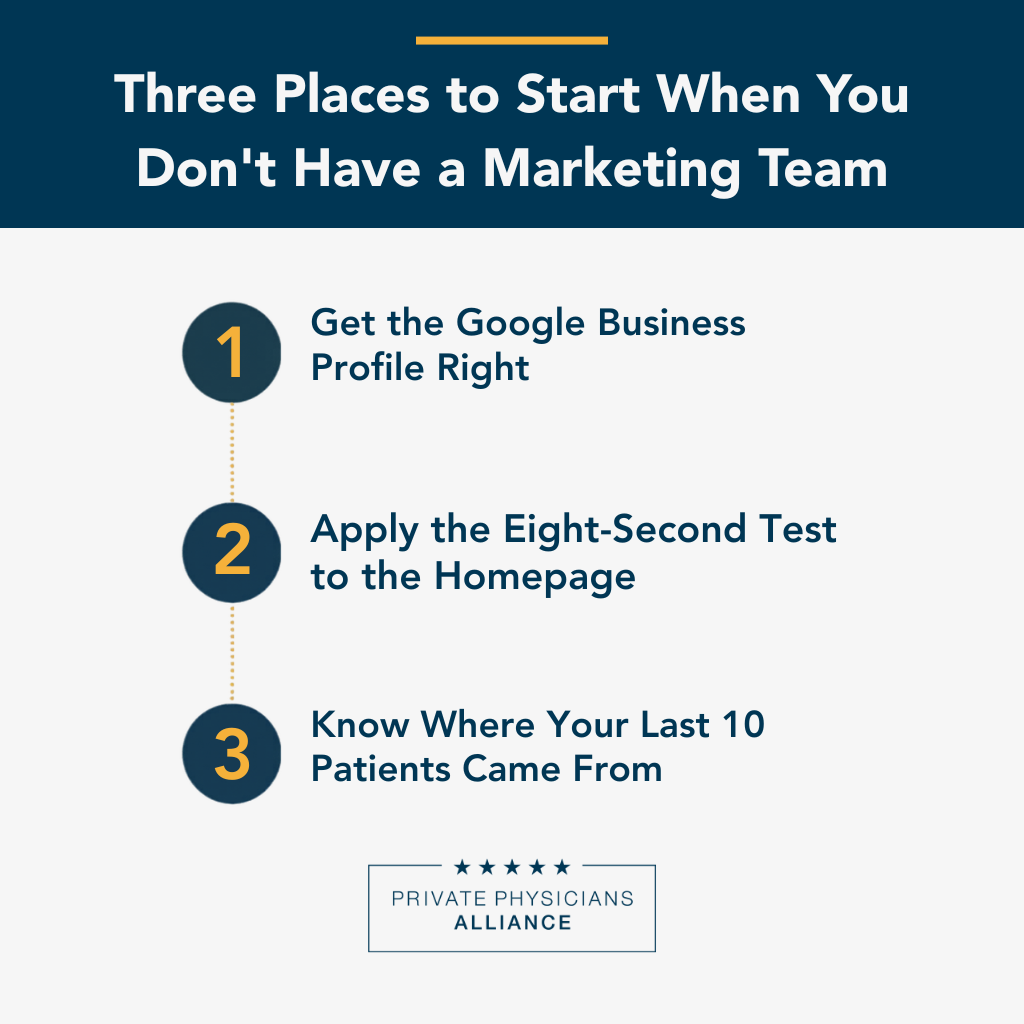
Win #1: Get Your Google Business Profile Right
When prospective patients hear about a practice, they go online to look it up. The Google Business Profile is often the first thing they see.
Trae explained that a search now shows AI summaries, sponsored results, and the three-listing map pack before the regular website results even appear. That sequence means a thin or inaccurate profile can cost a practice visits before its website ever loads.
The most common mistake is choosing a primary category that’s too broad. Trae sees practices select “medical clinic” or “doctor” when the more accurate choices are “Family Practice Physician” or “Internist.”
Getting the Google Business Profile right is the fastest way for a small practice to improve its online presence. No “concierge medicine” category exists, so practices have to pick the closest fit and use secondary categories accurately. Adding unrelated categories to appear in more searches tends to backfire.
The rest of the profile matters, too. The website link, phone number, hours, and business description should all be reviewed for accuracy. The description has room for searchable terms such as concierge or membership-based medicine, as well as the names of physicians prospective patients might be looking for.
Reviews feed into the same system. Trae noted that reviews now matter in more than one place. They influence traditional search rankings, but they can also feed the AI-driven summaries patients see when they search online. The catch is simple: patients only write strong reviews when the experience is worth talking about.
One Operations Leader on the call shared a tactic her practice uses. When a patient offers a compliment in person, staff respond warmly and then mention that an even bigger help would be a quick review. The compliment creates a natural opening, and the request doesn’t feel forced.
Win #2: Make Sure Your Homepage Passes the Eight-Second Test
Vince shifted the focus from search to what happens once someone clicks through. His standard: a homepage has about eight seconds to tell a visitor who the practice is and why they should stay.
Most concierge practice websites look polished. Far fewer answer the basics quickly.
Vince outlined three things every homepage should communicate right away: what the practice is, where it’s located, and what the visitor should do next.
Most practice websites don’t need a redesign; they need a homepage that answers three questions in eight seconds. The headline should plainly state the type of practice, whether that’s concierge primary care or membership-based medicine, instead of burying it in paragraphs further down. City and state, or neighborhood, should appear clearly because location shapes both patient decisions and search relevance.
The call to action is where many homepages lose visitors. Vince warned against cluttering the page with competing buttons, since the audiences a practice’s marketing reaches all need a single obvious next step. One clear call to action works better than five.
Roughly 65% of website traffic now comes from phones, so the homepage has to work on mobile. Vince urged attendees to pull up their own site on a phone and check four things: how fast it loads, whether the practice type is clear without scrolling, whether the phone number is easy to tap, and whether the main next step is obvious.
Vince’s broader point was reassurance. Most practices don’t need a full rebuild; they need targeted edits to wording, load speed, and button placement.

Win #3: Track Where Your Last 10 Patients Came From
Vince’s most pointed observation concerned the data that most practices don’t have. Most practices feel busy, but when asked where their last 10 new patients came from, they can’t answer clearly.
Without that data, every marketing decision is a guess. Staff time is spent on activities that may not be working, with no way to tell which ones.
The fix is simple. Every new patient inquiry starts with one question: “How did you hear about us?” The answer goes into the EMR, the CRM, a spreadsheet, or whatever system the practice already uses.
A practice that knows where its last 10 patients came from is in a different position than one that doesn’t. Vince said that about 90 days of tracking produces real patterns. After that, a practice can stop guessing and start directing time toward what’s working.
One member on the call had already started tracking. The data showed that the most recent patients came from Google searches and word-of-mouth referrals, which wasn’t where the team had been spending most of its marketing energy. The tracking surfaced a mismatch worth correcting.
Tracking the same data also informs larger decisions about how to grow a medical practice when the current panel fills up. Trae added a caveat. Attribution isn’t perfect, since a patient who says “Google” may also have been influenced by the website, social media, or a friend’s recommendation. Tracking imperfect data is still better than tracking none.
These are the kinds of practical, low-lift marketing changes for medical practice that can make a real difference for a private practice without adding a full marketing team. Within the Private Physicians Alliance, members share marketing strategies, patient experience ideas, and operational playbooks through private forums and monthly Ops Leaders Calls, such as the session that informed this blog post. If you’re looking for a peer network where concierge and DPC practices openly discuss what’s actually working, learn more about PPA membership.