Multi-Cancer Early Detection: What the Latest Data Shows
Updated Galleri and Signatera data from a PPA Afternoon Report session, including trial results, member cases, and what physicians need to run these tests in practice.

Most cancers don’t have a routine screening test. Breast, cervical, colorectal, lung, and prostate cancers do, but most other cancer types aren’t caught until symptoms appear.
A recent PPA Afternoon Report session covered updated clinical data on two blood-based technologies: GRAIL’s Galleri test for multi-cancer early detection and Natera’s Signatera for personalized recurrence monitoring. Dr. Eric Klein, Distinguished Scientist at GRAIL, and Dr. Jamie McKenzie, a medical oncologist at Natera, presented alongside PPA physician moderators Dr. Ran Goshen, Dr. Stacey Robinson, and Dr. Callie Hollenshead.
Why Multi-Cancer Early Detection Matters More Now
The value of cancer screening depends on the ability to treat and cure screen-detected cancers. As targeted therapy, immunotherapy, and surgical techniques have advanced, the return on finding cancer early has increased.
Overall five-year cancer survival in the U.S. has risen from about 50% in 1990 to roughly 70% in the most recent available data. Multi-cancer early detection is more valuable now because advances in treatment mean more cancers caught at treatable stages can be cured.
Stage 4 cancers account for about 20% of diagnoses but roughly 50% of cancer deaths. Dr. Klein argued the traditional grouping of stages 3 and 4 as “advanced” no longer holds; five-year survival at stage 3 is now meaningfully better than stage 4 across most cancer types. The more useful clinical question is whether a cancer was caught when curative-intent therapy was still an option.
What the Galleri Data Shows
Dr. Klein presented results from two major trials.
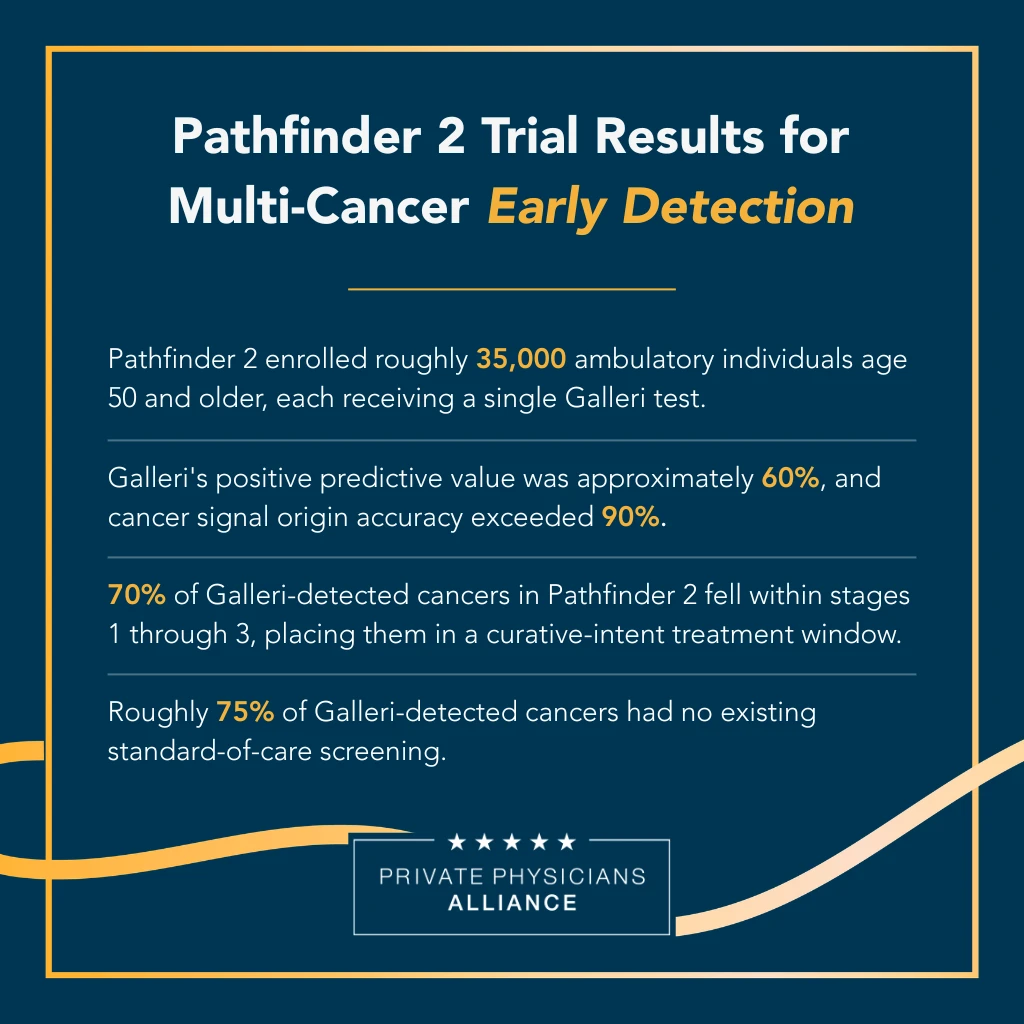
Pathfinder 2 enrolled roughly 35,000 ambulatory individuals age 50 and older, each receiving a single Galleri test. Galleri’s positive predictive value was approximately 60%, and cancer signal origin accuracy exceeded 90%.
About 70% of Galleri-detected cancers in Pathfinder 2 fell within stages 1 through 3, placing them in a curative-intent treatment window. Roughly 75% of Galleri-detected cancers had no existing standard-of-care screening.
NHS-Galleri, a randomized trial of approximately 140,000 people in the United Kingdom, compared standard screening alone to standard screening plus Galleri over three annual rounds. The trial didn’t meet its primary endpoint: a reduction in combined stage 3 and stage 4 cancers.
The data behind that endpoint told a different story: adding the Galleri multi-cancer early detection test to standard screening more than doubled the number of stage 1 and stage 2 cancers detected. Galleri alone found more stage 1 and 2 cancers than standard screening found across all stages combined. NHS-Galleri also showed a 26% reduction in stage 4 cancers among 12 pre-specified high-mortality cancer types and a 25% reduction in first cancer diagnoses in the emergency room.
The stage 4 reduction appeared to deepen over three consecutive rounds of screening, though the missed primary endpoint limits formal statistical conclusions on the secondary findings.
Data from GRAIL’s separate CCGA case-control study addressed a common concern about lead-time bias. Cancers with a positive Galleri signal had survival similar to conventionally detected cancers, while cancers with a negative signal appeared more indolent.
More aggressive tumors shed more cell-free DNA, so Galleri is more likely to catch dangerous cancers than slow-growing, clinically insignificant ones. Galleri doesn’t tend to detect low-grade or encapsulated prostate cancers and is less effective at catching certain lower-shedding breast cancers.
Galleri in Practice
Dr. Stacey Robinson shared that her practice has run roughly 500 Galleri tests with zero false positives. Two tests detected cancers that standard screening would have missed.
The first detected cancer was a stage 1 cholangiocarcinoma. The patient had resection and immunotherapy and has been Signatera-negative for nearly two years.
The second was a stage 2A lung adenocarcinoma in a 58-year-old non-smoker who didn’t qualify for standard lung cancer screening. The patient had resection, chemotherapy, and radiation and has remained Signatera-negative since treatment.
“I want to shout from the rooftop. Why are we not doing this?”
In both of Dr. Robinson’s cases, the multi-cancer early detection test caught cancers that existing screening missed. Galleri’s false positive rate in trials was less than 0.5%, compared with single- to double-digit rates for many existing screening tests.
Signatera: Personalized Recurrence Monitoring
Signatera uses a patient’s tumor tissue to identify mutations unique to that individual’s cancer, then builds a personalized assay to monitor for those mutations in blood over time. The assay targets clonal mutations that stay stable throughout a cancer’s evolution, so the same personalized test can detect recurrence years after the original diagnosis.
Circulating tumor DNA has a half-life under one hour. The biomarker shifts quickly with treatment or recurrence, and Natera has tested over 300,000 patients with Signatera across tumor types, including approximately 100,000 breast cancer patients.
Cancer recurrence monitoring with Signatera gives physicians a way to detect molecular relapse months before symptoms or imaging would. In a breast cancer cohort followed up to five years after curative-intent treatment, Signatera Genome detected recurrence an average of 13 months before clinical relapse. The earlier exome version of Signatera detected recurrence about 9.5 months ahead.
Dr. McKenzie emphasized the unmet need in breast cancer surveillance. Four million breast cancer survivors live in the U.S., and up to a third will develop a recurrence. Breast cancer treatment guidelines are updated multiple times a year, but breast cancer surveillance guidelines haven’t changed since the 1990s.
“The concerns about anxiety are more on the clinician side. Patients are anxious because we don’t do anything.”
ctDNA-Guided Treatment Decisions
Three cases from the session showed how ctDNA monitoring changed clinical decisions.
Dr. McKenzie described a patient with high-risk hormone-positive breast cancer who had chemotherapy, surgery, and endocrine therapy. The patient declined abemaciclib because of side effects, cost, and quality-of-life concerns.
When Signatera later turned positive with no metastatic disease on imaging, the patient agreed to start abemaciclib and quickly went Signatera-negative. “Without Signatera, I can be quite sure she would have shown up with metastatic disease that was incurable,” Dr. McKenzie said.
A second case involved a stage 1 lobular breast cancer patient considered low risk by standard tools. Six months into tamoxifen, Signatera showed a very low positive result with no findings on imaging. The patient switched to an aromatase inhibitor, a change standard risk assessment alone wouldn’t have prompted.
Dr. McKenzie said serial ctDNA testing lets physicians reassess whether a therapy is working, rather than making a single treatment decision at diagnosis and never revisiting it.
In a third case, cancer recurrence monitoring caught what standard follow-up missed. Dr. Robinson described a 79-year-old patient with stage 1, grade 3 endometrial cancer and a concerning peri-aortic lymph node that surgeons couldn’t fully remove. The patient’s specialist dismissed Signatera when the patient asked about the test.
One year post-treatment, Signatera turned positive. A PET scan confirmed recurrence in the vaginal cuff and the peri-aortic lymph node. After Dr. Robinson shared the Signatera report, the specialist confirmed recurrence with biopsy, and the patient received additional chemotherapy.
The specialist now orders Signatera for his own patients.
Practical Considerations for Physicians
Dr. Robinson recommended drawing blood before surgical resection when possible. A pre-resection positive confirms the tumor sheds a detectable ctDNA signal, so future negative results carry more weight.
Signatera requires tumor tissue for the initial assay, except in limited tissue-free indications currently available for colorectal cancer. Natera plans to expand tissue-free testing to lung, breast, and bladder later this year. Pathology labs typically retain tissue for years, and Natera handles specimen retrieval once physicians submit the paperwork.
The initial assay takes four to six weeks to build; subsequent blood draw results return in about seven days. Dr. Robinson cautioned against promising Signatera when the biopsy sample may be too small to create the assay.
GRAIL completed its FDA application in January 2026. Dr. Klein estimated feedback or approval around Q1 2027. TRICARE already covers Galleri, and the Nancy Gardner Sewell Medicare Multi-Cancer Early Detection Screening Coverage Act, signed into law in February 2026, allows Medicare to evaluate and potentially cover FDA-approved multi-cancer early detection tests.
For physicians adding multi-cancer early detection or cancer recurrence monitoring to their practice, building a relationship with a local oncologist comfortable with these tools is a practical first step. PPA members receive Galleri testing at $749 per test, with pricing dropping to $699 after a lifetime volume of 200 tests. Natera offers PPA members one-on-one consultations with medical directors about its oncology testing portfolio.
Private Physicians Alliance members can access the full recording of this Afternoon Report session, including the Q&A on ctDNA biology, brain metastasis detection, and detailed case discussions. PPA members receive preferred pricing on Galleri testing and access to Natera’s medical director consultations. Learn more about membership to join the conversation.