How Concierge and DPC Practices Can Turn a Waitlist Into a Warm Pipeline
A waitlist is one of the best problems a concierge or DPC practice can have — and one of the easiest to waste. Here’s how a deliberate content marketing strategy turns a passive queue into a warm pipeline of prospects ready to onboard.

Waitlists used to be rare in private practice. Now, they’re becoming a reality for many concierge and DPC practices with strong marketing.
That’s a good problem with a tough one underneath: Prospective members who sign up motivated and excited cool off fast without communication. Practices spend significant time and money attracting them, then risk losing them to silence.
A deliberate content marketing strategy for waitlist management protects that pipeline. It turns a passive queue into an active relationship and gives prospects a reason to stay engaged until a spot opens.
Why Waitlist Management Deserves a Dedicated Strategy
A six-month wait at your medical practice feels different to a prospect than a four-month wait for their current PCP. The numbers may favor you, but the framing doesn’t. Without communication, prospects start second-guessing the decision they were excited about a week ago.
Waitlists reflect a healthy practice, but they can feel like a closed door to the people on them. Silence makes the wait feel longer.
Waitlist management keeps prospects warm by treating the wait as a relationship-building period instead of dead time. A consistent stream of motivated prospects, ready to onboard when a spot opens, makes scaling beyond a full panel easier in every direction. Hiring, marketing budgets, and lease decisions all become easier to plan when patient flow is predictable.
Practices without an active waitlist system often experience boom-and-bust cycles, where the panel fluctuates with seasonal sign-ups and unmanaged churn.
Waitlist Management Starts in the Waiting Room
A waitlist is a digital waiting room.
You wouldn’t ignore a patient sitting in your lobby. You wouldn’t leave them with nothing to read. You’d acknowledge them, make them feel cared for, and remind them why they chose your practice.
Effective waitlist management applies the same standards of hospitality that define your in-office five-star patient experience. That means prioritizing consistent communication, useful content, and small personal gestures throughout the wait. Make prospects feel like patients before they technically are.

Content Marketing for Medical Practices: The Engine That Keeps Prospects Warm
Content marketing for medical practices is the tactic that scales. It lets you nurture dozens or hundreds of prospects with roughly the same effort it takes to nurture one.
The basics of content marketing for medical practices start with knowing who’s on the list. Collect demographic and preference information when prospects sign up. Are they senior executives, families, or retirees? Are they stressed and time-starved, or curious and engaged?
Content marketing for medical practices works best when topic, tone, and channel all match the audience you’re actually reaching. A practice serving busy executives might lead with stress management, sleep quality, and travel health. A family-focused practice might emphasize preventive care and pediatric questions. The same effort feels personal when it’s targeted.
This is the same logic that drives the rest of your concierge practice marketing: meet your audiences where they are and give them what they need.
The Email Series That Powers Waitlist Management
The welcome email sent immediately after sign-up does two jobs. It confirms the prospect’s decision and sets the tone for everything that follows. It’s also the right place to prompt any pre-registration forms you need filled out for future communications.
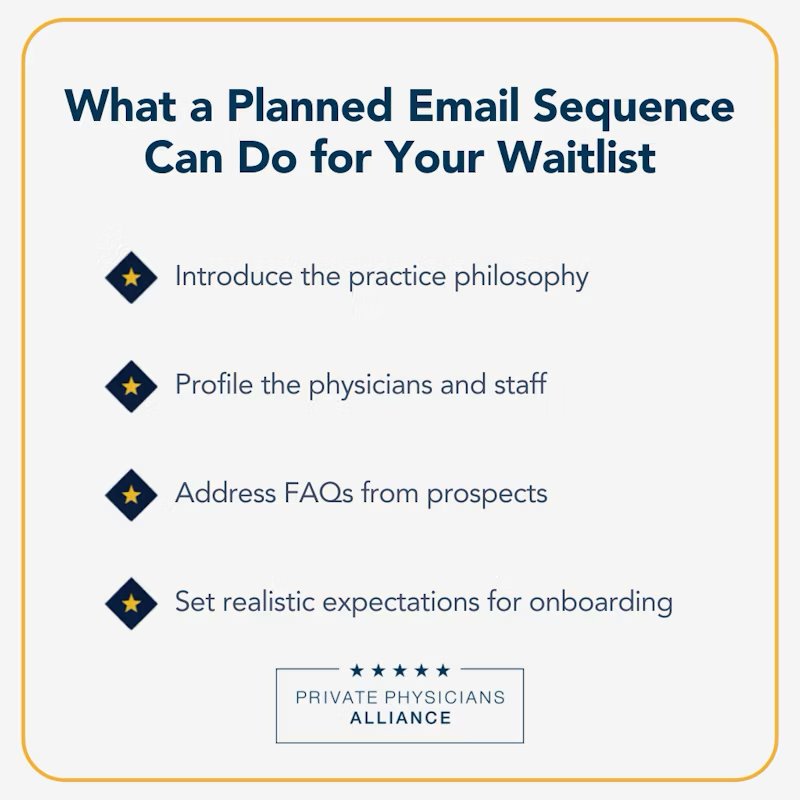
The series that follows is where the value compounds. A planned sequence can introduce the practice philosophy, profile the physicians and staff, address FAQs from prospects, and set realistic expectations for onboarding. FAQs work especially well trickled out one or two per email rather than dumped in a single PDF. The bite-sized format keeps each message useful instead of overwhelming.
A workable rhythm for most practices looks something like this:
- Welcome email immediately after sign-up
- Two to three onboarding emails over the first month covering practice philosophy, team introductions, and FAQs
- A monthly cadence afterward with educational content and practice updates
- Position check-ins quarterly, plus targeted outreach when a spot is close to opening
Email is the workhorse of waitlist management because it scales without losing the personal touch. Tools like MailChimp, Constant Contact, and HubSpot make automated sequences manageable for a small team. Some practices delegate the whole pipeline to a patient experience manager who owns prospect communication from sign-up through onboarding.
Whatever the structure, under-promise on timing so you can over-deliver when a spot opens.
Beyond Email: Using Content Marketing for Medical Practices to Build Trust
Email is the engine behind your waitlist management, but it isn’t the only content marketing channel for medical practices.
A blog provides prospects with substantive content to read while supporting SEO. Social media, especially LinkedIn for executive audiences, extends reach with light effort. One blog post can become three emails and five social posts. Repurposing keeps content costs low and maintains high volume.
Don’t underestimate the personal touches that cut through digital noise. A handwritten card on a birthday or a brief check-in note carries weight that an email can’t.
Strong waitlist management uses each channel to reinforce the others, so prospects feel known long before they walk into your office. For higher-touch practices, an open house or community event lets prospects experience your practice’s culture firsthand. Some practices host these quarterly. Others host smaller dinners or wellness talks on topics their audience cares about. The principle stays the same: keep showing up.
This is exactly the kind of operational detail that separates a full practice from a scalable one. Inside the Private Physicians Alliance, members share real-world email sequences, prospect communication strategies, content ideas, and waitlist management systems that are already working in concierge and DPC practices. If you’re looking for a peer network where physicians openly discuss what is actually helping them grow, retain, and manage their practices, learn more about PPA membership.